Jump to content

Olaf Bacon

Member Since 21 Apr 2012
Offline Last Active Today, 09:18 PM
*****

#59424 unable to open app

Posted by Olaf Bacon on 08 October 2026 - 12:00 AM

When the user is using a windows 32-bit application and is running on a windows 64-bit operating system, you may find that Task Manager and the option to analyze the wait chain tree will reveal that there are various wait chain processes that are using or waiting to use a resource that is being used by another process. The splwow64.exe printer driver was kept open by Microsoft and had not timed out or the process had not been terminated. Microsoft had kept that process open, as they expected that another print option would be requested. 

e-Sword user, PastorRusselH had used his e-Sword to print to a printer located at his church. He discovered that the most effective method was to remove that printer as the default printer to be used to print a document page from his PC or Laptop. Then the other printer options would be seen, which he uses when he connects his e-Sword on his device, to the printer in his home office. He could now select the required printer.  

So when you change the environment in which you use e-Sword, remember that the selection of the printer is one of the important ingredients in the solution. 


Something similar occurs when you want to preview what a page might look like if you were to print it - the size of font and the type of font affects how the characters would be positioned on the page, that is set to a specific width and length. When you send something to the printer, the printer, again, may reformat the content of the document page, including the additional header and footer details that include the file name, the title, and the date and time, and the source details, and the widths of the borders of the page, all over again. 


Again, when you LOGIN to biblesupport.com, if the login is ineffective, look in the access of the website name, and change the URL from https:// to http://

This will be important as from the beginning of October 2026, when the release of Chrome 154 will impact all users, worldwide, when Chrome's new HTTPS first-default will add a permission step before HTTP pages that load. The browsers will default to https:// by design. Then when you access Bible Support, if you first select the "Home" Tab, before you try to Sign In, this will be another helpful option. And try to remember to Sign Out, before you close the access to bible support - because this does not always time out correctly. 


#59380 e-Sword Revised Geneva Translation

Posted by Olaf Bacon on 29 September 2026 - 06:44 AM

The Revised Geneva Translation, Copyright © 2019, © 2024 by Five Talents Audio. All rights reserved. Used with Permission. 
To access the e-Sword edition, open e-Sword, select the "Dowload" option, browse down to the English language section of Bibles, in the Free option. Rick Meyers approved access as from September 3, 2026.
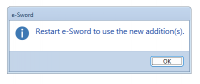
After download use the "X" in the top right corner to close the entry. Restart e-Sword to read the Revised Geneva Translation (RGT). 

Estimate 85 hours to listen to and read the Holy Scriptures Contained in the Old and New Testaments: Revised Geneva Translation at normal adult speaking speed of 200 words per minute. (includes pdf) - purchase details are available from https://5talentsaudio.com/


#59163 NRSVUE Preface To The Reader

Posted by Olaf Bacon on 15 September 2026 - 10:17 AM

New Revised Standard Version, Updated Edition w/ Apocrypha

New Revised Standard Version
Updated Edition
Contains the Hebrew Bible/Old Testament, the New Testament, and the Apocryphal/Deuterocanonical Books of the Old Testament
New Revised Standard Version Updated Edition, copyright © 2021, 2025 National Council of the Churches of Christ in the United States of America. Used by permission. All rights reserved worldwide.


To the Reader

From the National Council of the Churches of Christ in the USA


Motivated by love and respect for Scripture, the National Council of the Churches of Christ in the USA (NCC) hopes that you will find this New Revised Standard Version Updated Edition (NRSVue) suitable to inspire, inform, and guide daily living. The goal of the NRSVue is to offer a readable and accurate version of the Holy Bible to the global English-speaking community for public worship and personal study, for scholarship and study in classrooms, and for informing faith and action in response to God.


Together with religious leaders from diverse communities of faith, we join in the conviction that the Scriptures offer good news of God’s love—wisdom to guide, hope to sustain, truth to empower, forgiveness to change, and peace to bless all of creation.


The NRSVue extends the New Revised Standard Version’s (NRSV) purpose to deliver an accurate, readable, up-to-date, and inclusive version of the Bible. It also continues the work of offering a version as free as possible from the gender bias inherent in the English language, which can obscure earlier oral and written renditions. The NRSVue, like the NRSV, follows “in the tradition of the King James Bible, [introducing] such changes as are warranted on the basis of accuracy, clarity, euphony, and current English usage, . . . as literal as possible, as free as necessary” (NRSV’s preface “To the Reader”). As also stated in the NRSV preface, the Bible’s message “must not be disguised in phrases that are no longer clear or hidden under words that have changed or lost their meaning; it must be presented in language that is direct and plain and meaningful to people today.”


Why an Update?
The NRSV has been called the most accurate of English-language translations, based on the available manuscript evidence, textual analysis, and philological understanding. In the more than thirty years since its first publication, hundreds of ancient manuscripts have been studied in exacting detail. The NRSVue is informed by the results of this research. Laboring through this material has deepened scholarly insight into Jewish and Christian sacred texts and advanced understanding of ancient languages. With new textual evidence, historical insights, and philological understandings (which include exploring the meanings of ancient texts in light of the cultures that produced them), the NRSVue brings greater precision in interpreting Scripture today. The goal of these practices has been to translate the ancient texts as accurately as possible while reflecting the cultural differences across time and conditions. Such a translation approach permitted the Editorial Committee to present the text as literally as possible and as freely as necessary.
 

The Update Process
The current updating process involves scores of scholars and leaders from multiple faith communities, inclusive of gender and ethnic identities, with the unwavering goal to render an accurate version of original source texts into the most current understandings of contemporary language and culture.


It is for this reason, too, that the NCC commissioned the Society of Biblical Literature (SBL), the leading international association of biblical scholars, to review and update the NRSV. The SBL’s mandate and process were single-mindedly intended to ensure the currency and integrity of the NRSVue as the most up-to-date and reliable Bible for use and study in English-language religious communities and educational institutions.
 

A Final Word
Since its beginnings in the early 1950s, the NCC has supported the work of scholars who dedicate their lives to the study of the Hebrew and Christian Scriptures. Likewise, the NCC’s steadfast aim has been to encourage readers to study the Scriptures so they will be inspired and informed in their faithful action to love God with their hearts, souls, minds, and strength and to love each other as God loves.
The communions of the National Council of the Churches of Christ in the USA have undertaken this work as a sacred trust.


Preface to the NRSV Updated Edition

From the Society of Biblical Literature 
 

Purpose of the Revision
First published in 1611, the King James Version slowly but steadily attained a well-deserved stature as the English language’s “Authorized Version” of the Scriptures. At the same time, the scholarly foundation that produced the King James Version shifted as new manuscripts came to light and philological understandings improved. As a result of these scholarly advances, the Revised Standard Version was authorized to improve the translation, based on more evidence of the original texts and early translations of the Bible, the meanings of its original languages (Hebrew, Aramaic, and Greek, as well as ancient translations into Arabic, Armenian, Coptic, Ethiopic, Georgian Greek, Syriac, and Latin), and changes to the English language itself. The forty years between the Revised Standard Version and the New Revised Standard Version likewise witnessed many developments in biblical scholarship, textual criticism, linguistics, and philology. The same has occurred over the last thirty years, including the publication of all the biblical texts discovered near the Dead Sea, and these developments warrant this update. As with its predecessors, the NRSVue can claim a well-known line from the 1611 preface to the King James Version: “We never thought from the beginning that we should need to make a new translation . . . but to make a good one better.”


The National Council of Churches, which holds the copyright of the New Revised Standard Version, commissioned the Society of Biblical Literature to direct the NRSVue revision project thirty years after its original publication. The editors of this edition encourage readers to read the excellent prefaces to both the Revised Standard Version (1952) and the New Revised Standard Version (1989); some elements of the latter have been incorporated herein. This preface also outlines the process of the update and the mandate under which it was conducted.


Process of the Revision
The review managed by the Society of Biblical Literature included seven general editors and fifty-six book editors, with several general editors serving also as book editors. The general editors were divided into three teams: Old Testament (also known as the Hebrew Scriptures), Apocrypha (also known as the Deuterocanon), and the New Testament. In addition to the seven general editors, the National Council of Churches appointed two members of its Bible Translation and Utilization Advisory Committee to serve as liaisons to the committee of general editors appointed by the Society of Biblical Literature. Three members of the Society’s staff participated in and managed the project.


Beginning in 2017, each book of the Bible was assigned to one or more book editors. Over the course of two years (2018–2019), the book editors submitted their proposed updates to the general editors. Each of the three teams of general editors met at least once a month for two years (2019–2020) to review and discuss the proposed updates submitted by the book editors. The accepted updates were submitted to the National Council of Churches in 2021 for its final review and approval of what is now the NRSVue.


The NRSVue presents approximately 12,000 substantive edits and 20,000 total changes, which include alterations in grammar and punctuation.


Like its predecessors, this NRSVue has relied on the best results of modern discovery and scholarship. The mandate primarily focused on two types of revisions: text-critical and philological. The New Revised Standard Version Updated Edition (NRSVue) is not a new translation. While some stylistic improvements have been made, these were reserved for instances where the translation was awkward, unclear, or inaccurate. Other changes involve matters of consistency, grammar and punctuation, and general improvements that render the translation and notes more consistent and uniform.
 

Text-Critical Revisions
The role of text criticism in Bible translation is to establish a base text from which to translate, a text reconstructed from the earliest versions in the original languages (Hebrew, Aramaic, and Greek), as well as in ancient translations of the books of the Old Testament, Apocrypha, and New Testament. Translators rely on scholarly critical editions of the Bible for their work. A typical text-critical resource establishes a text based on scholarly judgment of the preferred reading among the readings available, with important alternative readings provided in a detailed apparatus. Scholars follow well-established rules in their effort to determine one preferred or superior reading from among others, though this remains both art and science. The challenge of establishing the Hebrew and Aramaic text of the Old Testament is different from the corresponding challenge in the New Testament. For the New Testament, a large number of Greek manuscripts exist, preserving many variant forms of the text. Some of them were copied only two or three centuries later than the original composition of the books. While the Dead Sea Scrolls dramatically improved the resources for Old Testament textual criticism, most translations, including the NRSVue, still rely especially on a standardized form of the text established many centuries after the books were written.


The goal of the text-critical review was to evaluate whether or not to modify the textual basis for the revision. To this end, the text underlying the New Revised Standard Version was examined in the light of all available evidence, making use of new data, perspectives, and scholarly resources. The review occasionally resulted in a change to the translation itself or to the textual notes that have been an integral feature of the New Revised Standard Version.


For the Old Testament, the team made use of the Biblia Hebraica Quinta (2004–) for those books published to date and the Biblia Hebraica Stuttgartensia (1977; ed. sec. emendata, 1983) for the remaining books. Both are editions of the Hebrew and Aramaic text as current early in the Christian era and fixed by Jewish scholars (the Masoretes) of the sixth to the ninth centuries. The vowel signs, which were added by the Masoretes, are accepted in the main, but where a more probable and convincing reading can be obtained by assuming different vowels, we adopted that reading. No notes are given in such cases because the vowel points are more recent and less reliably original than the consonants.


Departures from the consonantal text of the best manuscripts have been made only where it seems clear that errors in copying were introduced before the Masoretes standardized the Hebrew text. Most of the corrections adopted in the NRSVue are based on other ancient Hebrew manuscripts or on the ancient versions (translations into Greek, Aramaic, Syriac, and Latin), which were made prior to the time of the work of the Masoretes and which therefore may reflect earlier forms of the Hebrew text. In such instances a note specifies the manuscript, version, or versions attesting the correction and also gives a translation of the Masoretic Text.


Since the Dead Sea Scrolls and the Septuagint translation predate the Christian era, they present for certain books an earlier and more original version in the development of the texts. Each of the versions was considered authoritative by a community. This advance in textual scholarship is recent, however, so the NRSVue retains for its translation the version presented by the Masoretic Text, whether it attests the earlier, parallel, or later version. The differences between these major versions are larger than can be added to the notes.


The NRSVue uses double brackets in the Old Testament in the same way the New Revised Standard Version did in the New Testament: to enclose passages that are now regarded to be later additions to the text but that have been retained because of their evident antiquity and their importance in the textual tradition. In short, the text-critical basis for the Old Testament is an improved Masoretic Text, which was the goal of the New Revised Standard Version. The Masoretic Text has been given preference where there is no scholarly consensus in favor of another reading or where the arguments are equivocal.


The Revised Standard Version of the Bible containing both the Old and New Testaments was published in 1952; a translation of the Apocrypha in the Old Testament followed in 1957. In 1977, this collection was issued in an expanded edition containing three additional texts considered canonical by Eastern Orthodox communions (3 and 4 Maccabees and Psalm 151). Thereafter the Revised Standard Version gained the distinction of being officially authorized for use by all major Christian churches: Protestant, Anglican, Roman Catholic, and Eastern Orthodox. The translation of the Apocrypha, therefore, is not peripheral but of equal import as the translation of the Old Testament and the New Testament. Indeed, some of the deuterocanonical books were originally written in Hebrew or Aramaic and were considered sacred texts by the early Jewish communities who first transmitted them and the later Christians who preserved them.


The NRSVue includes a considerable number of changes to the Apocrypha. Because there is no single critical edition for the books in this collection, the team made use of a number of texts. For most books the basic Greek text used was the edition of the Septuagint prepared by Alfred Rahlfs (Stuttgart, 1935). For several books the more recent volumes of the Göttingen Septuagint project were utilized. A New English Translation of the Septuagint (Oxford, 2009) also served as a resource to compare translations and evaluate critical texts for individual books.


For the book of Tobit, the New Revised Standard Version relied on the shorter Greek manuscript tradition; the NRSVue translated the longer Greek tradition (preserved in Codex Sinaiticus), while taking the Qumran manuscripts and other ancient witnesses into account. For the three Additions to Daniel, the Committee continued to use the Greek version attributed to Theodotion. Ecclesiasticus has an especially challenging textual history. The team generally followed the Greek text of Joseph Ziegler (and the versification in the Prologue), while giving particular consideration to the earliest Hebrew manuscripts from the Dead Sea region, with occasional recourse to the Syriac. The versification of 1 Esdras now follows Robert Hanhart’s edition (Göttingen, 1974), which also brings the book into conformity with its usage in the Eastern Orthodox tradition. The basic text adopted in rendering 2 Esdras is the Latin version given in Robert Weber’s Biblia Sacra (Stuttgart, 1971), with consultation of the Latin texts of R. L. Bensly (1895) and Bruno Violet (1910), as well as by taking into account the Syriac, Ethiopic, Arabic, Armenian, and Georgian versions. Since the Additions to the Book of Esther are disjointed and unintelligible as they stand in most editions of the Apocrypha, we provide them with their original context by translating the entirety of Greek Esther from Hanhart’s edition (Göttingen, 1983). The versification of the Letter of Jeremiah now conforms to Ziegler’s edition (Göttingen, 1957, 1976). The Septuagint’s Psalm 151 is an abbreviated version of the Hebrew composition found in the 11QPsalmsa scroll. While the Greek remains the basis for the translation, the team also consulted that scroll.


For the New Testament, the team based its work on three recent editions of the Greek New Testament: (1) The Greek New Testament, 5th revised edition (United Bible Societies, 2014); (2) The Greek New Testament: SBL Edition (Society of Biblical Literature and Logos Bible Software, 2010); and, (3) for Acts and the Catholic Letters, Novum Testamentum Graecum: Editio Critica Maior (Deutsche Bibelgesellschaft, 2013, 2017). Occasionally these editions differ in regard to text or punctuation; in such cases the team followed the reading best supported by a combination of both traditional and more recent approaches and considerations. As in the original NRSV, double brackets are used to enclose a few passages that are generally regarded to be later additions to the text but that have been retained because of their antiquity and importance in the textual tradition. Here and there in the notes the phrase “Other ancient authorities read” identifies alternative readings preserved by Greek manuscripts and early versions. In both Testaments, other possible translations of the text are indicated by the word “Or.”


Textual criticism continues to evolve. Not only have additional manuscripts become available, but some of the goals and methodology have changed over the last several decades. This is more the case for reconstructing the books of the Old Testament and Apocrypha, but it is generally true for the entire enterprise. In the NRSVue, care was taken not to push too far ahead of the existing critical editions or to turn the translation itself and its notes into a critical edition. Nevertheless, a careful reader will notice in general a more generous use of the notes for alternative readings. The editors hope that this work will serve translators in the future.
 

Philological Revisions
Deciphering the meanings of the Bible’s ancient languages involves a host of efforts: the study of the languages themselves, the comparative study of cognate languages from the ancient Near East and the Greco-Roman world, the disciplines of philology and linguistics, and the historical study of the social, cultural, and economic contexts in which the Bible was written. The NRSVue took special care not to use terms in ways that are historically or theologically anachronistic, though, as in every translation, anachronism is unavoidable.


The NRSVue continues and improves the effort to eliminate masculine-oriented language when it can be done without altering passages that reflect the historical situation of ancient patriarchal culture. This goal is to provide a historically accurate and acceptable rendering without using contrived English. Only occasionally has the pronoun “he” or “him” or other gendered language been retained in passages where the reference may have been to a woman as well as to a man, for example, in several legal texts in Leviticus and Deuteronomy. In such instances of formal, legal language, the options of either putting the passage in the plural or of introducing additional nouns to avoid masculine pronouns in English could easily obscure the historical background to and literary character of the original. In the vast majority of cases, however, inclusiveness has been attained by simple rephrasing or by introducing plural forms when this does not distort meaning.


The NRSVue also continues the well-established practice of using in the Old Testament the word LORD (or, in certain cases, GOD). This represents the traditional way that English versions render the Divine Name, the “Tetragrammaton” (see the notes on Exodus 3.14, 15), following the precedent of the ancient Greek and Latin translators and the long-established practice in the reading of the Hebrew Scriptures in the synagogue.
 

The Future of Revisions and a Virtue of This Translation
The NRSVue represents a base text that was produced from a variety of textual witnesses, a text that was not used by any one community but combines readings from several of them. This, however, may well be a model and a reminder to us today: it results in a text that can be used across both Jewish and Christian traditions and in all their diverse communities. Indeed, this model stretches back to 1611, the origin of this edition. The translators of the King James Version took into account all of the preceding English versions and owed something to each of them.


In 1977 the Revised Standard Version incorporated books that permitted it to become officially authorized by all the major Christian churches, and the use of the Masoretic Text of the Hebrew Scriptures reflects the use of that text in synagogues. Beginning with the Revised Standard Version Bible Committee, the translation teams became both ecumenical and interfaith. The process that produced this translation of the Bible represents an ideal and a virtue. It is a Bible produced by consensus that can be used among and across pluralistic communities in contexts both academic and religious.


In the future, new text-critical resources will become available, the methodology and goals of textual criticism may change, translation theory may evolve, and the need to reflect contemporary language will be constant. In short, efforts to update the translation of the Bible will continue. As they do, it is the hope of the Society of Biblical Literature that this translation will continue to be produced by a diverse team and for diverse readers.


#58897 NRSVUE - Chapter and verse numbering

Posted by Olaf Bacon on 03 September 2026 - 11:16 PM

You should raise your concerns with estudysource.com as the provider of the Bible resource package.

Thank you for your recommendation. I have raised the missing details on the NRSVUE website, regarding the Copyright details, Foreword, Preface, and Translators To The Readers for the © 2021, © 2025 updated edition, provided for e-Sword on the Download option as from 2026-January-14, with scribenet.com  


#58812 NRSVUE Information

Posted by Olaf Bacon on 30 August 2026 - 01:06 AM

When you download the NRSVUE you will receive four files, NRSVue, NRSVue+, NRSVAue, NRSVAue+ as illustrated in the attached Thumbprints. The contact options to e-StudySource is also shown.

Attached Thumbnails

  • Screenshot 2026-08-30 124323.png
  • Screenshot 2026-08-30 123421.png
  • Screenshot 2026-08-30 125134.png
  • Screenshot 2026-08-30 130143.png


#58783 e-Sword 15.2 and beyond wish list

Posted by Olaf Bacon on 28 August 2026 - 04:38 PM

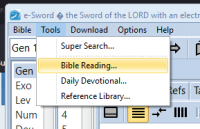
MrJazz, In the Bible Reading Plan, when you have completed reading the current reading that you are working through, select the icon to the extreme right, and click that icon, to indicate "Completed Reading" relating to the current reading. The bookmark will indicate the current reading as having been completed. Then the Bible Reading Plan immediately moves the bookmark to the following entry in the programmed sequence.

You want to completely read, understand, and implement the lessons you understand during your reading the complete volume of all the scriptures as soon as possible. Then you can teach these lessons to others by having implemented the good character traits in your own lifestyle.

AI expects that a normal reader, based on a standard adult reading speed of 200 to 250 words per minute, will take about 67 to 75 hours of continuous reading, to read the entire standard Christian Bible straight through at a normal Bible Reading speed. Pausing to look at footnotes, cross-references, or study notes will double or triple the total time

Now you can teach others what you have learned and are implementing in your own character traits as you look around and implement new ways to improve life for others who are now part of your new family, with no restrictions on age or abilities, gender or access to wealth.

Attached Thumbnails

  • Screenshot 2026-08-29 052616.png
  • Screenshot 2026-08-29 053606.png


#58771 NRSVUE Information

Posted by Olaf Bacon on 27 August 2026 - 05:36 PM

NRSVUE Information
New Revised Standard Version, Updated Edition. Copyright © 2021, 2025 by National Council of the Churches of Christ in the United States of America. All rights reserved, Used with permission.
Provided in e-Sword format as from 2026-01-14.

Please view the official New Revised Standard Version Updated Edition (NRSVue) licensed user website. nrsvue.scribenet.com  because in my entry I discovered that the content in the "Information" field was blank in the copy updated 2026-01-14.

The National Council of the Churches of Christ in the USA (NCC), through its affiliate Friendship Press, is the copyright owner of the NRSVue and adaptations and translations thereof. The latest list of errata were published July 1, 2025, on the official New Revised Standard Version Updated Edition (NRSVue) licensed user website.

(The following information is taken from NCC’s “Policies and Guidelines for Licensees.”).
All editions of the Bible published, reproduced, and distributed must be faithful to the text of the NRSVue and the manner of its presentation as determined by NCC. The NCC has two general style and formatting principles: (i) to maintain the text of the NRSVue in its integrity and (ii) to maintain the clear readable setup of the NRSVue without cluttering the text with unnecessary indicators of one sort or another. In light of these principles, the NCC has adopted the following style and formatting requirements for Licensees. Where an item is indicated as being a “Licensee item,” Licensee may propose an approach; however, all style and formatting decisions are subject to the approval of NCC.

Style and Formatting.
Text, notes, and footnotes. Text, notes, and footnotes are an essential part of the NRSVue Bible file and are to be maintained in their integrity. This includes the maintenance of [a] title pages, [b] “To The Reader,” and “Preface to the NRSVue,” [c] the titles of the various books, [d] the list of abbreviations for the notes; and [e] footnotes. Footnotes must use the entire alphabet before beginning over with “a.” Footnotes must be recycled at each new book, and each new book must begin with the first footnote marked “a.”

ADDITIONAL NOTE: On my e-Sword running on Windows 11 and (e-Sword for the PC version 15.2.0) the Information for four NRSVue, NRSVAue, NRSVue+, NRSVAue+ versions is totally blank. Why this information is missing is unknown. Please contact the source (Petradi International Rights Services manages the rights and permissions for the NRSVue) for further details of who maintains the e-Sword edition - this is not likely to be a problem caused by Rick Meyers the developer of e-Sword.


#58582 Module for Obolo Bible

Posted by Olaf Bacon on 17 August 2026 - 08:33 PM

Katelem, browse up to the top of this web page where your query is, and click on the FOLLOW THIS TOPIC, then you will get notifications. http://www.biblesupport.com/topic/21112-module-for-obolo-bible


    There are NO employed webmasters working here - only volunteer Moderators, (who are getting older every day), and volunteer members who reply to interesting user's queries. E-sword for the PC has been updated to version 15.2. (August 14, 2026). 


Go and ask your contact with the Wycliffe translators - I provided you with the people who are in charge of the latest rules of language for that area - they will be able to provide written permission for an e-Sword version to be made, and provide the source in electronic format, to Rick Meyers, the developer of e-Sword. Rick@e-sword.net


Then Rick Meyers can arrange for the entry to be available on the "Download" option, for all varieties of e-Sword, for access by all who use e-Sword, world-wide, just like with many other Bibles. 


#58539 Graphics rendering problem in e-Sword 15.2 on ARM64 devices

Posted by Olaf Bacon on 15 August 2026 - 05:10 AM

On InstallShield Wizard checking Installation, the wizard was interrupted before e-Sword xould be completely installed. Your system has not been modified. To complete installation at another time, please run setup again. Will try again. I think there was a internet glitch or a power glitch.
.


e-Sword InstallShield Wizard. The setup must update files or services that cannot be updated while the system is running. If you choose to continue, a reboot will be required to complete the setup. [That's like version 15.0 problem all over again]. The position of the validating install was at position 4.8 of 11.4 total width of the progress bar. I will say OK. It continues okay. It's taking time at windows fonts - seems to be adding some fonts. Sends me to donate page. Tells me "You must restart your system for the configuration changes made to e-Sword to take effect. Click Yes to restart now or No if you plan to restart later." Will restart and see which version this is.


e-sword version 15.2 removed all my new Topic Note files in which I had written details of e-Sword changes for different options. This is the same habit that had previously happened. That's not good at all. Why DELETE MY FILES in the C:\users\Administrator\documents\e-Sword folder? I don't know if they were backed up to the cloud or not, because that kind of book-keeping is done by Microsoft and when the internet is has problems (usual in South Africa), and internet goes off, - then what - does it mean all new user files are again lost.?


after internet access was restored, and Firefox restored access, my previous Topic notes files returned.

It's not fair to expect my PC to LOGIN to Tennessee, and it I abort that donation, not to allow the program to END gracefully, and WRITE the files from Cashe memory back into the user's drive. So if the internet access is terminated, then the installation is not completed? That's not fair.


The maps from the download option in e-Sword are received, and remain in This PC > Windows (C:) < ProgramData > e-Sword in *,refx format. They don't need to be changed to "refi".

I provide the dates these entries were provided in the e-Sword "Downloads" option.

REFERENCE BOOKS
English Free
2022-12-08 Alliterated Bible Outlines (Harold Willmington). Published in 2018; licensed under a Creative Commons Attribution-NonCommercial-Share Alike 4.0 International License.
2026-07-14 American Bible Society Maps (Graphics). Copyright © 2004 by The American Bible Society.
2026-07-14 Ancient Mediterranean (Graphics). Copyright © 1998 by Interactive Ancient Mediterranean.
2026-07-14 Bible Timelines (Graphics). Copyright © 2006 by Rick Swartzentrover.
2026-07-14 Classic Bible Maps (Graphics). Public domain.
2026-07-14 Larkin's Book of Charts (Graphics) Published in 1918, 1920; public domain.
2026-07-14 Mitchell's Ancient Geography (Graphics) Published in 1844; public domain.
2026-07-14 Rand-McNally Bible Atlas (Graphics) Published in 1910; public domain.
2026-07-14 Scripture Atlas (Graphics) By Mathews and Leigh, London. Published in 1812; public domain.
2026-07-14 Smith Bible Atlas (Graphics) George Adam Smith. Published in 1915; public domain.


#58499 Font issues in e-Sword 15 and Rick Meyers response

Posted by Olaf Bacon on 12 August 2026 - 08:07 AM

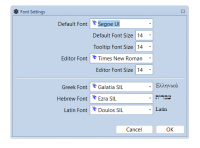
Here are the fonts that work with the different options, as tested with e-Sword for the PC version 15.1.1 Default Font = Segoe Size 14, Tooltip Font Size 14,
Editor Font Times New Roman Editor Font Size 14.
Greek Font Galatia SIL
Hebrew Font Ezra SIL
Latin Font Doulos SIL

two-sox which e-Sword module are you trying to read? Do you have a reasonably modern monitor? and PC?

Attached Thumbnails

  • e-Sword Default Fonts version 15.1.1 2026-08-12.png


#58387 Module for Obolo Bible

Posted by Olaf Bacon on 06 August 2026 - 03:24 AM

Kathleen, please inform us of who has translated this Bible, who has the copyright, will it become obsolete after the Catholic American Bible is released in February 2027, and who has given permission for it to be provided freely on e-Sword. Also who will provide the text in electronic format, and confirmation that they will maintain the version changes in future. Also where hard copies in printed format can be obtained, to be used to check the quality of the e-Sword version after it has been created for the Obolo Bible. 

You did not provide any details of follow up of who to contact, and in which language the contacts can be made (if someone wanted to do this as a conversion project into e-Sword format. )

The Obolo language is spoken by the Obolo people (also known as the Andoni people) in the coastal regions of Rivers State (Andoni Local Government Area) and Akwa Ibom State (Eastern Obolo and Ibeno Local Government Areas) in Nigeria. 

Can someone please make a module for Obolo Bible?
Obolo people would like to also wield this Sword of the Lord with an electronic edge.

Who Speaks Obolo
  • Native Speakers: Approximately 250,000 to 400,000 people speak Obolo as their primary native tongue.
  • Dialect Groups: It includes six major dialects: Ataba, Unyeada, Ngo (the standard/prestige form), Okoroete, Iko, and Ibot Obolo. 
Languages Spoken and Understood by Obolo Leaders
Because of regional trade, governance, and neighboring groups, community and traditional leaders typically speak and understand: 
  • English: Used for official government communication, formal education, and administration in Nigeria.
  • Nigerian Pidgin: Widely used as a common inter-community trade and communication lingua franca across generations.
  • Neighboring Regional Languages: Depending on proximity, leaders often understand regional languages like Igbo, Ibibio, or Efik, as well as neighboring Niger Delta languages (such as Ibani/Bonny) due to long-standing historical, cultural, and commercial interactions.

    SIL International & Wycliffe Translators: Collaborates extensively on initial linguistic analysis, grammar guidelines, and translation software tools.


#58276 Comments on UI changes in Version 15

Posted by Olaf Bacon on 30 July 2026 - 11:00 PM

With e-Sword for the PC version 15.1.0 (updated by Rick Meyers 21 July 2026) the diacritic marks added to a letter to indicate a different pronunciation, stress, tone, or meaning, and diaeresis where a vowel is to be pronounced separately from the previous vowel, and may be replaced by another letter when transliterated into another language, some characters of which do not display correctly when using Verdana as the default font, display okay when the default font is changed to True Type Times New Roman, which apparently has an extended range of letter characters. 

Rick Meyers appears to have implemented previous suggestions. To see the information name of the book you have open, use Right click. This applies to Bible, Commentary, Lexicon, and Dictionary. That's where the transcriber of the book into e-Sword added the front-page details of the name of the book, the author, the publisher and the copyright details, and may have copied the information that appeared in the FOREWORD and the PREFACE, and other important Information pages that appeared before the pages of the text of the book. 


#58224 Mysword replacing bible chapter with book chapter and notes.

Posted by Olaf Bacon on 26 July 2026 - 05:26 AM

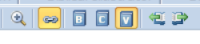
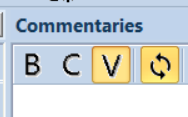
When reading notes in a Commentary, there are three view options.

B (Display Book Comments)

C (Display Chapter Comments). The list of appropriate verse links are probably also listed.

V (Display Verse Comments). This has comments if they were linked separately for the selected verse number, in the selected Book and Chapter number.

Attached Thumbnails

  • Screenshot 2026-08-29 045005.png
  • Screenshot 2026-08-29 045035.png


#58199 Comments on UI changes in Version 15

Posted by Olaf Bacon on 24 July 2026 - 06:25 AM

Patriotjd, Thank you for the suggestion.
To find information about the book I am viewing, with e-Sword for the PC version 15.1.0 (updated 21 July 2026).

All that is needed is to Right-click in a blank area of the view where the contents are displayed, then select "Information" from the popup menu.

This option applies to each of the Bibles. Commentaries, Dictionaries, and Lexicons.


#58022 Afrikaans 2020 translation

Posted by Olaf Bacon on 14 June 2026 - 01:19 AM

SUGGESTION: If you create an e-Sword module that provides access to a new Book, you could then contact the copyright owners and offer to provide them with the e-Sword module that you have created for your own use, and explain to them what resources you used to create the e-Sword modules.
Advise them that they can test your work by downloading the e-Sword for Bible Study application from https://www.e-sword.net/ and offer that they can test your module, and then also suggest that if they find it works up to expectations, then they could contact the e-Sword developers at https://www.e-esword.net with the provision of their permission to implement their books on e-Sword as maintained by the e-Sword developers, officially. By them providing their data in electronic format, then the e-Sword developers, Rick Meyers and Joshua Meyers, and their friends could check that the details provide for the new needs of e-Sword for Windows 11, e-Sword x for the Mac, e-Sword HD for the iPad, e-Sword LT for the iPhone, and e-sword for Android.