Jump to content

Todd Sumrall

Member Since 19 Dec 2020
Offline Last Active Sep 06 2026 03:19 AM
*****

#58077 I had to get a new computer that is missing necessary fonts

Posted by Todd Sumrall on 10 July 2026 - 04:35 PM

Thank you!


For the Ancient Hebrew Lexicon of the Bible there are SEVEN different True Type font files, as follows:
ancheb.ttf  bsthebre.ttf  olbheb.ttf  semear.ttf  semlate.ttf  semmid.ttf  semmod.ttf  

You will find these fonts at http://www.biblesupport.com/e-sword-downloads/file/8694-jeff-a-benner-ancient-hebrew-lexicon-of-the-bible/ The Submitter is identified as david psalms. On the Bible Support web page there is a clear instruction: Note: Please install the fonts attached.

Irrespective of the type of e-Sword which you are using, you need to download the ahlb fonts. These are in the file ahlbfonts.zip 
This file, after you have downloaded it, needs to have the contents all extracted. When you do so, you will find that there are seven different entries inside this unzipped file folder. Each of these seven fonts need to be installed onto your computer device, into the relevant fonts folder. 


#58038 Fixing e-Sword Module Font Overrides and Black-on-Black Mobile Text Bugs Usin...

Posted by Todd Sumrall on 20 June 2026 - 05:27 AM

For the longest time, I struggled with a frustrating issue when creating Bible and commentary modules: e-Sword's user-defined font controls simply wouldn't work. The display was locked into whatever font type and size I originally used to create the module, with no way for the end-user to change it.

To make matters worse, I hit another roadblock when loading the modules onto my iPhone. I use a black background on mobile, and the text rendering was completely inconsistent—sometimes it would show up white, but other times it stayed black, making it completely invisible.

After plenty of trial and error, I finally figured out the root cause and how to fix it. I created this video tutorial to share the solution so you can save time and make sure your modules display flawlessly for everyone.


https://youtu.be/dgF8hjDu-Es


Are you creating e-Sword modules using NT Tooltip but running into frustrating font or display issues?

If you are experiencing problems where user-defined controls in e-Sword fail to change your module's fonts, or font colors are not respecting the user's default settings—causing major readability issues like black text on a black background on mobile devices—this video is for you.

In this tutorial, we will walk you through exactly how to fix these formatting bugs so your modules display flawlessly and dynamically across all devices, including dark mode settings on smartphones.

What You Will Learn:

  • How to resolve font override issues with user-defined controls in e-Sword.

  • How to fix text color conflicts (e.g., black text on black backgrounds) for mobile users.

  • Best practices for formatting your source files in NT Tooltip to ensure cross-platform compatibility.


Don't let formatting glitches ruin your hard work. Watch this step-by-step guide to ensure your e-Sword modules look great on any screen!


#49488 Sir Lancelot C.L. Brenton's 1851 translation of the Septuagint (LXX) incl...

Posted by Todd Sumrall on 14 February 2026 - 04:02 AM

Is there a module of Brenton's LXX that has the Apocrypha in it? I know he originally published it with it included.

Thanks


#49154 I Messed up tooltip again.

Posted by Todd Sumrall on 10 November 2025 - 06:10 AM

I just wanted to do a quick update. Windows did an update the other day and what do you know, it fixed whatever the problem was. I no longer have to spend time making modifications to copy from Word to Tooltip to prevent Greek word messups! I am so happy!


#49034 Ctrl C Error 20056 Can't Copy to Clipboard

Posted by Todd Sumrall on 19 October 2025 - 03:10 AM

I read an old locked thread about this issue. I was wondering if anybody found a solution yet? I got a new computer and this has been an ongoing issue. I can right click and copy, but cannot use Ctrl C, the faster way, to copy.


ctrl c.png


#48889 I had to get a new computer that is missing necessary fonts

Posted by Todd Sumrall on 01 September 2025 - 04:55 AM

Hi,

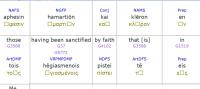
I need to know what fonts I need to install to make sure the Greek and Hebrew fonts display correctly. Apparently my new computer doesn't have them. Thanks

Attached Thumbnails

  • fonts i need greek hebrew.jpg


#48669 Recommendations for Bibl Dictionary/Lexicon

Posted by Todd Sumrall on 12 July 2025 - 06:44 AM

I highly recommend Complete Word Study Dictionary: OT and NT for e-Sword Spiros Zodhiates. Though not free and has to be purchased from eStudysource.com, it is worth the price, if deep dive into the languages for word studies is the goal.
https://estudysource...-nt-for-e-sword


#48474 Any Greek Reverse Interlinear for the Septuagint?

Posted by Todd Sumrall on 06 June 2025 - 12:41 PM

Does anybody know if there is a module that has the Greek for the Septuagint in reverse Interlinear format similar to the BSB reverse Interlinear BLBr.bbli ?


#48193 Is there a way to join modules on submission to bible support?

Posted by Todd Sumrall on 02 May 2025 - 09:31 PM

I recently submitted a LXX translation of Genesis bbli. I also submitted a translation notes commentary module cmti. Currently a person needs to go to two separate pages to get both modules. I noticed that the Berean Bible has all their modules together. I didn't see a way to do that when I submitted mine. I would like to keep them grouped together if possible. Thanks.


#48146 I have completed my LXX translation of Genesis with a translation notes comme...

Posted by Todd Sumrall on 23 April 2025 - 06:45 AM

If you would like a copy on my translation of Genesis from Septuaginta, hg. v. Alfred Rahlfs, zweite, verbesserte Auflage, hg. v. Robert Hanhart, © 2006 Deutsche Bibelgesellschaft, Stuttgart and the translation notes commentary module, let me know in a private message here at Bible Support and I will be more than happy to give you a link so you can download the filles in a zip format. You will need to know how to install them manually.


genesis bible support.jpg


#48076 Almost done with my Genesis LXX Translation. AI translation assistance has be...

Posted by Todd Sumrall on 07 April 2025 - 08:47 PM

I’ve been busy translating Genesis from the LXX. My original plan was to translate the entire Rahlfs 2006 updated edition. I started in December 2024, and I’m just now getting to the finishing touches—four more chapters of translation notes, and I’ll be done. But I’m 60, and at this rate, Jesus will either have returned, or I’ll be dead before I get that far! But I will go as far as I can.


One reason it’s taken so long is that I wasted who knows how many hours trying to find an AI solution to assign Strong’s numbers to words in the LXX that already exist in Strong’s. I tried GPT. I tried Grok. I tried every method I could think of. I finally gave up sometime in January. AI kept assigning numbers to words not in Strong’s and missing words that were. Nothing worked. So I gave up and decided to create detailed translation notes and put them into a commentary module instead. And let me tell you, those notes are what have taken up the most time. The translation itself only took about six weeks. But organizing the notes into something coherent and figuring out a consistent format? That’s been a real challenge.


Let me talk about this adventure. I’ve learned a lot. Translating has opened my eyes to God and His world in a way nothing else ever has. It’s been amazing—indescribable, really. He and Jesus have become my reality in a way I had never experienced before. Truly understanding the Gospel starts in Genesis. Seeing how God manages everything down to the smallest details—it’s all there. Genesis reveals that His power exceeds every known limit—and even the ones we don’t know. I could go on and on.


This journey propelled me to translate some New Testament books as well. I’ve started with Ephesians and Philippians. Wow. What an eye-opener. It’s simply amazing.


None of this would have been possible without AI. I do have a working knowledge of Greek—basic stuff like moods, verbs, nouns, rough breathing marks, the alphabet. I can spell words (though I can’t pronounce them), and I understand diphthongs, vowels, and things like that. I use the polytonic Greek keyboard that comes pre-installed on both PC and Mac, which lets you type in Koine Greek with all the breathing marks and accents. I definitely couldn’t write Greek by hand! Without that keyboard Microsoft includes with their OS, I’d be lost. I’m not a Greek scholar—probably not even at a first-year student level. All of this is self-taught.


So I use AI with that basic Greek knowledge and know when to ask questions to clarify things. My head has been absorbed with the Bible for a long time, and I’ve read it from cover to cover more times than I can count. I’m not saying this to boast—only to say that without at least some of this background, using AI for Bible translation is a fool’s errand. You cannot blindly trust AI. It will hallucinate, and if you can’t spot those hallucinations, you’ll end up with a mess. You have to explore everything it gives you, ask the right questions, dig deep. If you accept what it spits out without question, you’ll get blind man results. That’s all I’m saying. And you must compare everything with established translations—I use four different ones for that very reason.


Let me give you a prime example of what I mean by hallucinating and  “blind man results.” It happened to me.


This translation work has gripped me hard. I’m at it 10, 12, sometimes 16 hours a day, 7 days a week. The Book of Jubilees has always fascinated me, but I’ve never been happy with the current English translations. So, I thought, “Why not do it myself?” Jubilees is based on the Ethiopic Ge’ez text, which is a language I know absolutely nothing about. But after completing my LXX Genesis translation, I felt confident in my process and ability to ask the right questions. Famous last words!


I’m now 25 chapters deep into translating Jubilees. It’s been slow going, because my translation would often differ from other versions—sometimes every other verse. So I’d get the Ge’ez breakdown for each verse. Sometimes I’d find the mistake and bring my translation in line with the others. But most of the time, I wouldn’t.


So I had GPT compare my translation against the other version and the Ge’ez text. It would generate a line-by-line comparison, put it all in a table, and occasionally agree with the other translation—sometimes revising mine and explaining why. MOST of the time, it would say the other version took interpretive liberties, while mine stuck closer to the literal Ge’ez. I accepted that and began writing notes explaining where the other translation strayed—sometimes outright ignoring the Ge’ez and adding in whatever they wanted.


Then I came to a verse where our translation made absolutely no sense. No matter how I reframed the question, GPT just wasn’t coming up with anything better. Now, Genesis and Jubilees have a lot in common—it’s often called “Little Genesis.” It has a stronger covenant focus and gives more detailed family info than Genesis. But they generally agree on the big stuff. So I knew something was off. GPT was willing to bend the text in the direction I thought it should go—but I have a strict “let the text speak for itself” rule. I won’t let GPT modify anything based on my assumptions.


Still, this verse was clearly wrong. So I tried Grok. Boom—Grok produced the same translation as the version I had been comparing to all along. Meanwhile, GPT was out in left field—or on the moon.


So I spot-checked a few other verses that had felt off. I hadn’t pushed on them before because I thought the other translations were taking liberties or skipping things. But nothing was theologically problematic—until now. And again, Grok’s translations matched the standard one closely.


So I started questioning Grok. That’s when I learned Ge’ez is a minor language used mostly in the Ethiopic church, with few manuscripts and limited scholarly resources. AI in general, including Grok, isn’t fluent in Ge’ez. Grok explained that GPT was hallucinating—essentially guessing—and doing it in a way that seemed logical and convincing. That blew my mind… and cost me about 100 hours.


That’s why I say: you should probably know something about the language and the Bible before trying to use AI for translation. For me, because I know Genesis so well, it helps keep me grounded. I’d actually argue that knowing the Bible well—from cover to cover, in multiple English translations—is more helpful than just knowing the original language. This whole experience has been wild. And even though my method for arriving at a final translation was solid, GPT was hallucinating—like it was dropping LSD—and making everything sound legit. That’s why you have to be extremely careful when using AI to translate the Bible, Second Temple period texts, or early Christian writings.


Yeah… this has been a real adventure, that’s for sure!


#47732 Almost Done With LXX Genesis Translation, Back to Strong's Numbers

Posted by Todd Sumrall on 23 January 2025 - 08:30 AM

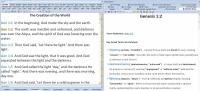
There are a few reasons I want to translate the LXX (Septuaginta, hg. v. Alfred Rahlfs, zweite, verbesserte Auflage, hg. v. Robert Hanhart, © 2006 Deutsche Bibelgesellschaft, Stuttgart). I'm not happy with the available translations. Some are not an easy read, NETS, Lexham LXX (Lexham not available for eSword either). Brenton's is somewhat archaic, and APB+ closest to perfect but missing the apocrypha and a non strong's number version. So, my desire is to create a modern readable version staying true to the greek, and a +Strong's version. Getting strong's numbers has been a challenge. I fought with GPT for a while and sought out other solutions and just gave up. It seemed that it was too much for GPT to sort out and was assigning numbers to words that have no numbers etc. Now that I am almost done with the book of Genesis, I am revisiting the Strong's issue.


Today I got to thinking. What if I have GPT assign strong's numbers to the actual greek text we have been using to create the translation from and then have GPT look at the translation we have done and take the strong's numbers from the greek text and insert them in the proper places in the translation? Well, that seems to be working. I have been checking against the APB+ and so far so good, even though there are differences because of the difference in manuscripts the translations are based on. Obviously this is very time consuming, but the desire for a regular version and a + version were my top 2 reasons for taking on this project. Making it for eSword reason #3. The apocrypha and a companion translation notes/commentary are reason 4 and 5.

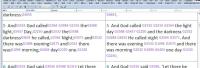
I said all of that for this reason. The way GPT is grouping the strong's numbers sometimes is not like the APB+. I wonder if you guys would consider this grouping format to be acceptable? I have found the less rules I give to GPT, the better and more consistence the results are.


grouping.jpg


#47697 WHY NKJV is not a free-to-read module on BibleSupport

Posted by Todd Sumrall on 16 January 2025 - 07:09 PM

Because it costs money:)


#47696 Synching Esword with the cloud

Posted by Todd Sumrall on 16 January 2025 - 07:07 PM

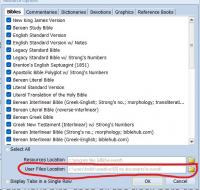
Go to >options>Resource Settings and make a entry similar to this but your cloud drive.


cloud.jpg


#47656 Anybody know of software to add strong's numbers?

Posted by Todd Sumrall on 11 January 2025 - 01:56 AM

thanks. ChatGPT works great when it works. Knowing that computers work on rules, I have a well defined set of rules and examples for it to adhere to. Some days it does it perfectly, comparing the Greek and Masoretic against the translation and inserting numbers and some days I have to input the same passage a half a dozen times before it gets it!